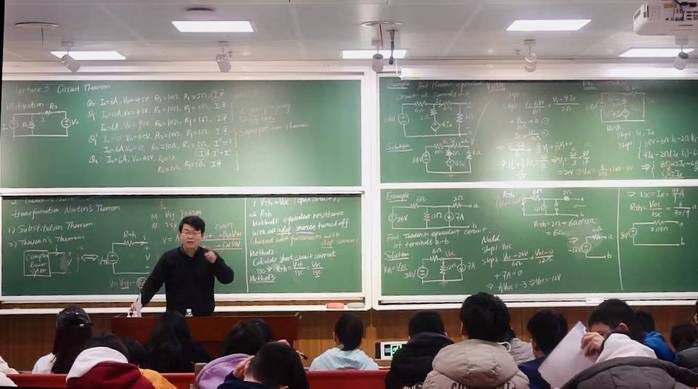
In December, the Ministry of Education officially announced the list of courses that are recognized as third batch of National First-Class Undergraduate Courses. ShanghaiTech’s two undergraduate courses—“Social Engagement Education” and “Electric Circuits”—have been selected, marking another milestone in the university’s ongoing efforts to advance development in course content and teaching.
Social Engagement Education
This is a mandatory credit course for all undergraduate students at ShanghaiTech. Themed “Understanding the national condition and experiencing hardship,” the course has been offered every summer since 2015. Its topics have always aligned with the university’s commitment to serving national strategies and socio-economic development needs, focusing on key national initiatives such as the transition from targeted poverty alleviation to rural revitalization. During the course, students, under the guidance of faculty, apply knowledge and methodologies in politics, economics, design thinking, and their academic majors to conduct in-depth field investigations at social engagement bases. They identify and analyze local opportunities and challenges, and propose feasible solutions. The course has achieved remarkable teaching outcomes and has been recognized as a first-class undergraduate course in Shanghai. Thanks to the course’s solid organization and outstanding teaching results, ShanghaiTech has been honored as a national outstanding institute for social engagement education.

Labor education is part of the course content
Electric Circuits
This course, offered since 2015, has been taken by a total number of 1,834 undergraduate students. As a foundational course in the electrical disciplines, it is primarily designed for students majoring in Electronic and Information Technology, Computer Science and Technology, and related fields, aiming to systematically train students’ basic academic abilities in circuit and system analysis and design. The course integrates “domestic situations” and “global perspective” throughout the teaching process, laying a solid theoretical, experimental, and learning-habit foundation for students’ future studies, research, and innovation. The course relies mainly on blackboard teaching, using clear derivations to help students follow the course content. It also emphasizes an integrated mindset that combines physics and mathematics to deepen understanding. Furthermore, it supplements learning materials with supporting MOOC video resources. In terms of circuit experiments, the course integrates theoretical teaching with corresponding hands-on practice. The experimental circuits for teaching are well-designed for implementation, and comprehensive project-based experiments are designed to inspire students’ practice passion. In addition to the course content, this course encourages classroom interaction and guides students to lay a solid foundation through daily study.