

Recently, the team led by Professor Hu Peijun at the School of Physical Science and Technology (SPST) at ShanghaiTech University made significant progress in the field of AI-driven materials science. Their independently developed machine learning interatomic potential model, TACE (Tensor Atomic Cluster Expansion), demonstrated exceptional performance and was featured on Matbench Discovery, a globally authoritative leaderboard in machine learning materials discovery.
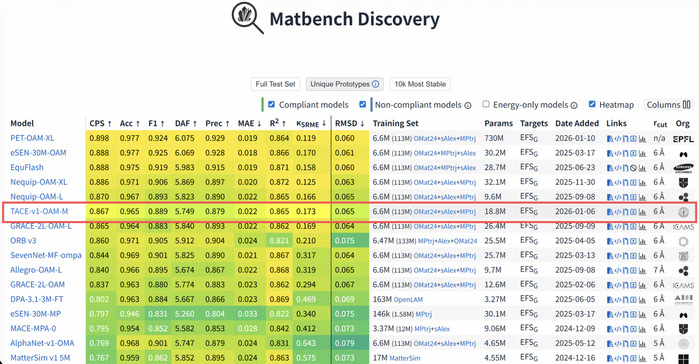
As of January 6, 2026, the universal model version of TACE (TACE-v1-OAM-M) ranked 6th globally in the overall standings of Matbench Discovery. It successfully surpassed numerous traditional architectures to become the highest-ranking Cartesian-based model on the list, while also leading all ACE-type (Atomic Cluster Expansion) models.
The TACE framework innovatively introduces the Irreducible Cartesian Tensor (ICT) theory. Evaluation results from Matbench Discovery confirm that TACE can achieve or even exceed the predictive accuracy and expressive power of large-scale spherical harmonic models (such as MACE, GRACE, and Allegro) with a more streamlined model size. Furthermore, the TACE framework deeply integrates the team’s self-developed REICO (Nat Catal 8, 891–904 (2025)) dataset construction strategy, which focuses on multiphase catalytic reaction systems. This dual innovation in both “data and model” provides a formidable computational engine for the rational design of catalysts and the analysis of complex reaction mechanisms.
The model was trained by Xu Zemin, a visiting student in Hu’s group, under the guidance of Research Assistant Professor Xie Wenbo and Professor Hu Peijun.