

Wang Yiru, born in 2000 in Xinxiang City, Henan Province, is a 2024 PhD student trained jointly at the School of Life Science and Technology (SLST) and the Shanghai Institute for Advanced Immunochemical Studies (SIAIS). During her doctoral studies, she published research papers as co-first author in top international journals including Cell, Science Advances, and Nature Communications.

Awards and honors:
1. 2025 National Scholarship for Doctoral Students
2. ShanghaiTech University Outstanding Student (2023–2025 academic years)
3. Second Prize of the 2025 Roche University Research Fund from the Chinese Society of Biochemistry and Molecular Biology
Research dreams come true
Biology was Wang Yiru’s favorite subject in middle school. Through classroom learning and extracurricular discussions, she gradually came to appreciate the breadth and depth of this discipline—from invisible microbes and viruses to humans, mountains, rivers, lakes, the entire Earth, and even extraterrestrial life—all fall within the scope of biological research. In her view, biology, as a science centered on life, draws from everyday observations while embodying universal natural laws.
In 2018, Wang was admitted to the College of Life Sciences at Henan Agricultural University, where she continued exploring the mysteries of life science. The professors’ engaging lectures and meticulous experimental guidance inspired her deep admiration for science researchers and strengthened her resolve to pursue a research career and explore the unknown. After graduating with her bachelor’s degree, Wang was recommended for admission in 2022 to the SLST at ShanghaiTech University to pursue graduate studies, officially embarking on her scientific research journey.
Upon entering ShanghaiTech, Wang initially felt lost in choosing a research direction. Through laboratory rotations, she encountered structural biology. What fascinated her most about this field was its principle of “seeing is believing”—at atomic or near-atomic resolution, it reveals the three-dimensional structures, dynamic processes, and functions of biological macromolecules, making the microscopic world, which is invisible even to the naked eye or optical microscopes, clearly visible, directly uncovering the underlying mechanisms of life activities. She developed a strong interest in the field and ultimately joined the laboratory of Nobel Laureate Professor Roger D. Kornberg at the SIAIS.
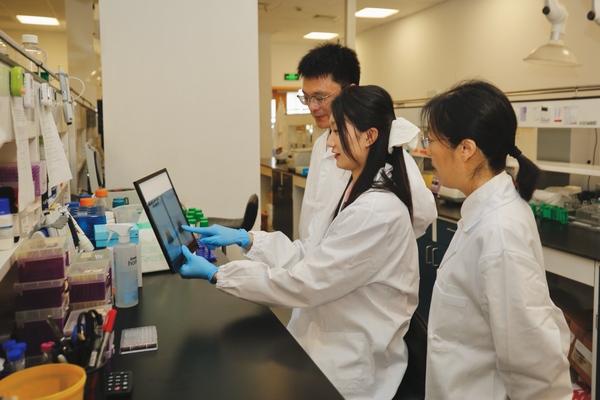
Wang Yiru (middle) conducting research with her team members
Under the dedicated guidance of her supervisors, Wang expanded her research focus to the critical public health area of viral infectious diseases, with particular emphasis on Nipah virus and measles virus which are highly pathogenic RNA viruses. Nipah virus frequently emerges in Southeast Asia with a fatality rate as high as 75%, and no specific drugs or vaccines are currently available, making drug development extremely urgent. Meanwhile, measles virus, once nearly eradicated, has resurged globally due to declining vaccination coverage, causing over ten million infections and hundreds of thousands of deaths each year, posing a persistent public health threat.
For RNA viruses, their most central and conserved drug target is the RNA-dependent RNA polymerase (RdRp) they encode. This is the core machine for viral replication and transcription, and the key to producing progeny viruses. Wang and her research team aimed to use this polymerase as a breakthrough point, employing structural biology methods to systematically dissect its working mechanism. Their goal was to “know thyself and know thy enemy” at the molecular level, to design efficient and specific small-molecule inhibitors, and ultimately achieve precise intervention, thereby building a solid drug reserve to combat emerging and sudden viral threats.
However, the path of scientific research is not always smooth. Repeated exploration and setbacks before breakthroughs are the norm. Structural biology research is highly time-sensitive, and Nipah virus is a hot research topic, meaning the team had to race against time. Yet for a long period, failure loomed over Wang like a dark night—the exhaustion of repeated protein purifications that yielded no results, the frustration of trying countless cryo-EM conditions only to fail due to poor particle orientation, and the despair of suddenly seeing a preprint paper that was almost identical to her work.
Despite the bumpy road, Wang and her team never wavered. They persisted, tackled challenges one by one, and ultimately succeeded in resolving the high-resolution structure of the Nipah virus polymerase, revealing the conserved molecular mechanism by which this viral family recognizes template RNA. In subsequent studies, the team not only determined the cryo-EM structures of the measles virus polymerase in complex with two non-nucleoside inhibitors, but also identified inhibitors targeting the Nipah virus polymerase based on structural insights. Moreover, the two novel drug-binding pockets they discovered provide critical structural foundations and new targets for the design of broad-spectrum antivirals against the Paramyxoviridae family. These research achievements were published in Cell and Science Advances, respectively.
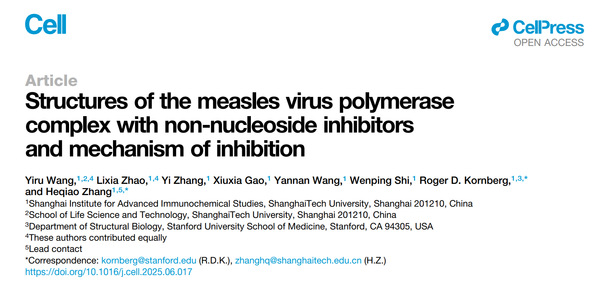
Wang Yiru’s first-author publication in Cell
Wang Yiru will continue to delve deeply into the world of structural biology. Using viral polymerases as the “key,” she uncovers pathogenic mechanisms at the atomic scale and provides critical scientific evidence for antiviral drug development.
In the future, she hopes to continue exploring in the field of infectious disease prevention and control where the country needs it most, integrating her personal scientific ideals into the cause of public health development.