

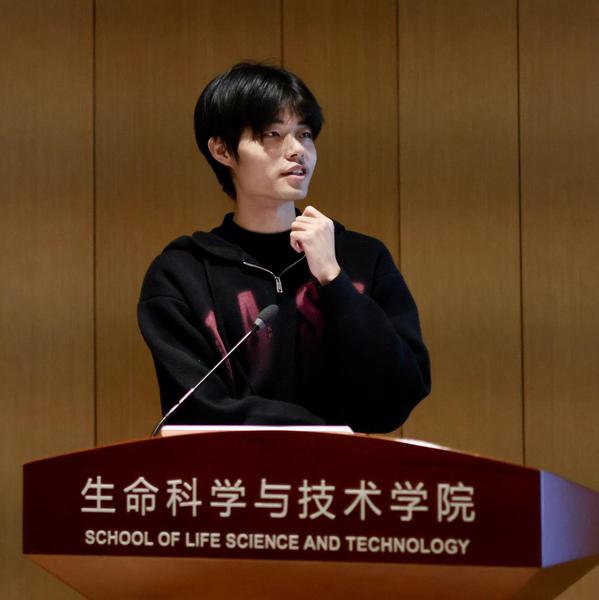
Liu Qizhen is a Class of 2026 undergraduate at the School of Life Science and Technology (SLST), majoring in Biological Sciences with a minor in Finance. He has been honored as a ShanghaiTech Outstanding Student for three consecutive years.
Honors & Awards:
- iGEM Gold Medal (2023–2025)
- SynBio Challenges 2024 Gold Medal
- SynBio Challenges 2025 Silver Medal
- ShanghaiTech Outstanding Student Award (2023–2025)
- ShanghaiTech Outstanding Student Leader Award (2023–2024)
Research journey starts from iGEM
Liu Qizhen’s research journey began in his freshman year when he joined the 2023 iGEM team. He played a pivotal role in selecting the team’s project, ultimately choosing “Cyanobacteria Bioluminescence.” To optimize the experiment, he independently studied computational biology and neural networks, developing an LSTM (Long Short-Term Memory) prediction model that successfully predicted fluorescent protein properties and filled critical gaps in existing genetic databases. His expertise in “wet lab” experimental skills and “dry lab” computational expertise helped propel the team into the Global Top 10.
Following the competition, Liu sought to translate the project into real-world applications. In 2024, he led the team to design an E. coli system that simulates DRG neurons to sense and inhibit itch signals, resulting in a functional anti-itch skincare prototype. In 2025, serving as academic advisor, he guided the new iGEM team to focus on “Granzyme K in Sinusitis,” ensuring the continued excellence of ShanghaiTech’s iGEM tradition.
Through three years of iGEM experience, Liu developed a deep appreciation for the joy and creativity of scientific research. He came to realize that scientific discoveries can effectively address real-world challenges, which solidified his aspiration to pursue a career in academic research. At the same time, overcoming numerous challenges during the competition helped him grow from an ordinary team member into the core leader of the team. He not only understood the responsibilities of leadership but also mastered the art of efficient collaboration and team cohesion. This journey became a defining highlight of his undergraduate years.
Interdisciplinary exploration in research
While in high school, Liu developed a strong interest in infection and immunity. Upon entering university, he quickly joined the Shanghai Institute for Advanced Immunochemical Studies (SIAIS) and engaged in research internships, focusing on projects related to the host protease TMPRSS2. In this project, he successfully constructed the target plasmid and achieved protein expression and purification in an insect cell system. Through this work, he systematically mastered protease research techniques, crystallography fundamentals, electron microscopy operation, and data processing, rapidly enhancing his scientific capabilities.
His research on TMPRSS2 further deepened his interest in the interactions between pathogenic microorganisms and their hosts. Building on his previous experience in virus-related projects, he began exploring whether small-molecule inhibitors could directly target key bacterial proteases to tackle clinical challenges such as Staphylococcus aureus infections. With support from his supervisor, he proactively took on this research direction starting from his sophomore year. Over the course of one year, he overcame multiple technical bottlenecks—including protease self-degradation, inclusion body formation, and unstable enzyme activity—successfully establishing an efficient screening platform, and screening 3,600 small-molecule compounds, ultimately identifying promising lead molecules.
To further broaden his research horizons, Liu also joined Professor Chi Tian’s research group at SLST, participating in a project focused on target discovery for inflammatory bowel disease (IBD). In this interdisciplinary project, he learned advanced experimental design and techniques for gRNA capture, gaining a more comprehensive understanding of complex biological problems and developing a broader vision of life sciences.
Enhancing responsibility through field immersion program
Guided by ShanghaiTech’s philosophy of its field immersion program—stepping out of the campus, engaging with society, and understanding national conditions—Liu actively participated in various volunteering and public service activities during his undergraduate years. During the summer of his freshman year, he traveled to the Daliang Mountains in Sichuan Province, where he conducted in-depth research on local fundamental education. Drawing upon his own knowledge, he designed and delivered a series of engaging courses on Chinese classical literature for local students. His lively and interactive teaching style was warmly received by both teachers and students. After the program, he and his teammates completed a report that won the Second Prize in ShanghaiTech’s Undergraduate Field Immersion Program in 2023.
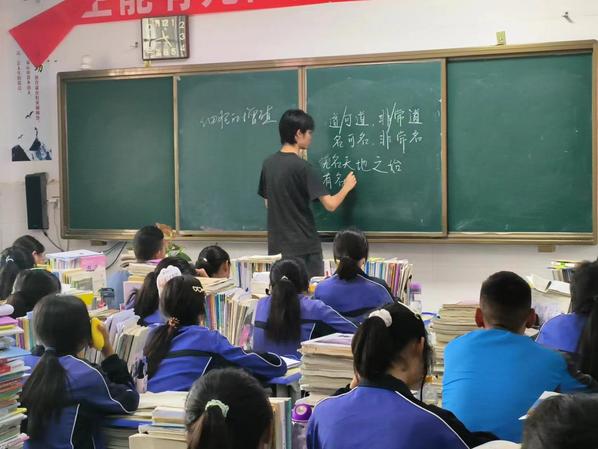
Liu Qizhen teaching Chinese traditional culture to high school students in the Daliang Mountains
In addition, he took on several student leadership roles on campus, serving as president of the Speech Club and vice president of the iGEM Club. In his spare time, he actively participated in volunteer services, including as a volunteer for the Shanghai Marathon and caring activities for left-behind children, practicing social responsibility through dedicated service.
Exploration at the intersection of finance and biology
During his freshman year and participation in the iGEM “Cyanobacterial Lamp” project, Liu planted the seed of “creating value through technology.” His subsequent experiences in field immersion and industry immersion further deepened his understanding of how entrepreneurship can serve society. He saw real needs, and clearly defined his mission—to respond to reality through innovation to the best of his ability.
To build a solid foundation in entrepreneurship and technology transfer, he began pursuing a minor in Finance starting from his freshman year. After intensely studying financial theories such as pricing models, he developed an original dynamic game algorithm. He boldly applied this algorithm to the field of protein design, which also shares Markov chain characteristics, to generate protein binding interfaces with high affinity. This cross-disciplinary exploration received positive recognition from his professors.
Entering his senior year, Liu took two diverse steps in entrepreneurial practice. On one hand, he founded LeucineBioTech to explore innovative services in protein production. On the other hand, addressing the need for interpersonal connections on campus, he led the development of the internet platform TekNexus, which was successfully launched for trial operation in December 2025 and has received positive initial feedback.
From the international stage of iGEM to the classrooms in the remote Daliang Mountains, from protease research in the laboratory to coding for entrepreneurial platforms, Liu Qizhen’s undergraduate journey has followed a clear trajectory—determining direction through exploration and achieving innovation through interdisciplinary integration. He has not only honed solid research capabilities and cross-boundary skills but has also grown into a youth with the spirit of science, humanistic care, and social responsibility.