

Last week, Frank Wise, the Samuel B. Eckert Professor at Cornell University and a Fellow of both the Optical Society (Optica) and the American Physical Society, delivered a lecture at the ShanghaiTech Lecture Series. Titled “New Fiber Sources of Femtosecond Pulses,” the talk offered both cutting-edge insights and academic depth. The event was chaired by Xie Xiaoming, dean of the School of Physical Science and Technology (SPST).
A globally recognized leader in ultrafast optics, Professor Wise is renowned for his contributions to fiber lasers and nonlinear fiber optics. He began by revisiting the fundamental principles of nonlinear pulse propagation. Compared with solid-state lasers, which have long dominated ultrafast science, fiber lasers offer significant advantages in compactness, stability, and cost efficiency. Tunable femtosecond pulse sources, he noted, hold great promise for applications ranging from biological imaging to precision manufacturing. Conventional approaches have typically sought to avoid nonlinear effects, however at the same time, they suppress pulse quality, limiting the performance of fiber lasers relative to their solid-state counterparts. Professor Wise proposed an alternative perspective: by actively harnessing nonlinearity, it is possible to overcome gain-bandwidth limitations and open new technological pathways.
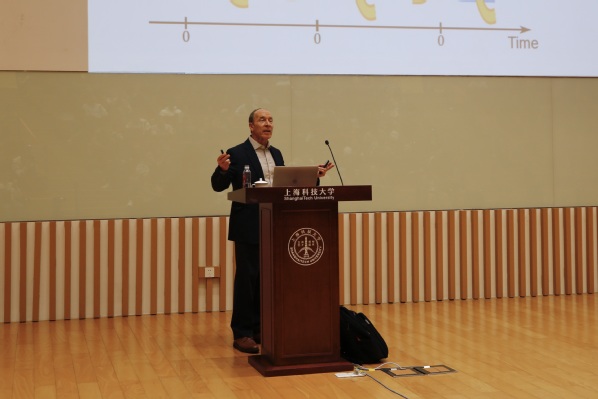
Frank Wise
Building on this concept, the lecture highlighted two recent advancements. The first involves a new class of nonlinear fiber amplifiers capable of generating higher-energy, shorter pulses (on the order of 1–10 μJ and ~40 fs) while avoiding gain narrowing, laying a new foundation for high-performance fiber oscillators. The second focuses on wavelength conversion in hollow-core fibers, achieving energy conversion efficiencies of up to 50% and pulse durations as short as 60 fs. Professor Wise also presented compelling applications of these sources in deep-brain functional imaging, vividly illustrating the convergence of fundamental physics and frontier biomedical research.
During the Q&A session, the audience engaged actively with questions on topics such as gas-based nonlinear control strategies in hollow-core fibers and the future of novel light sources in biological imaging. Professor Wise responded with clarity and depth, and his insightful perspectives and open academic style were met with enthusiastic applause. Following the lecture, Yin Jie, executive vice president and provost, presented Professor Wise with a commemorative certificate on behalf of the university.
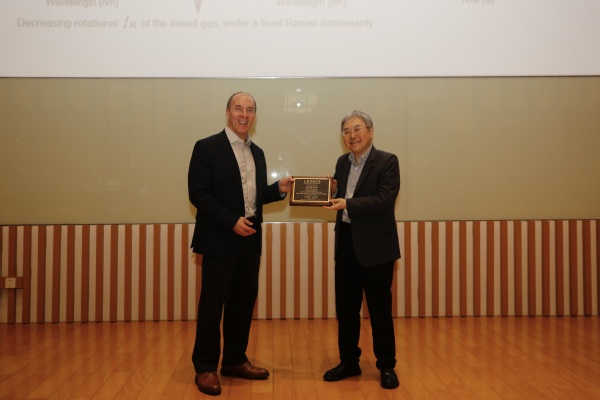
Yin Jie (right) presenting the certificate to Frank Wise (left)
As ShanghaiTech’s flagship lecture platform, the ShanghaiTech Lecture Series is dedicated to fostering dialogue with leading scholars worldwide and promoting the exchange of frontier ideas. Professor Wise’s visit not only showcased the latest advances in nonlinear fiber optics, but also demonstrated—through the lens of “harnessing nonlinearity”—the profound and elegant interplay between fundamental research and technological innovation, bringing renewed intellectual vitality to the campus community.